Showing posts with label Childhood memories. Show all posts

Long Lost Childhood Games - Chuppa Chuppi / Hide-n-Seek / Ice Spies

Get ready for a nostalgic drive, for am taking you through the memory lanes of our childhood days. 

We all have plenty of fond memories attached to those bygone days. Apart from school, one major work we used to do as kids was play, play and play whether its indoor or outdoor. The  outdoor games have almost become extinct now, thanks to the busy and hectic lifestyle. And we hardly find any unoccupied plots or open grounds like earlier.

Here is a small attempt to revive those lost childhood games or traditional Indian games which we used to play and enjoy as kids. 

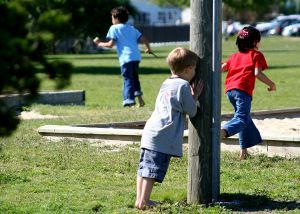
Next in the series is Hide and Seek or Chuppa Chuppi or Ice Spies (not sure how it is spelled, but we used to pronounce like this, or may be Eyes Spies/Ice Spice even.) It was one of the preferred game especially during power cuts. Hope you have checked the earlier ones Channe ManeKancha (Goli)Gilli Danda (Chinni Dandu), Spinning Top/LattuLagori (Pittu)

Long Lost Childhood Games - Hide and Seek / Chuppa Chuppi

Rules of the Game :

The rules of the game were almost same as present day. 

selecting one player by tossing palms in the air called "claps"
The team chooses one player who will close his/her eyes clasping his hands normally against a wall or a tree and counts upto 10 (if the player was young enough he was given to count upto 10, for all others it was always 100, which he would count in his fastest speed by fast forwarding and jumping few numbers in between ;))

[The process of choosing that one player (called the out-player) was by various means. We used to follow something like this with tossing the palms of all the players in air together. I think we used to call something like "Claps", yes!]

1. Ok, now when this player is counting the numbers in his own speed and correctness, others would hide in their favorite hiding places. 

2. After finishing counting he goes on a hunting spree and has to spot each player. He has to run back to the counting place as soon as he spots a player and touch the wall/tree saying Ice Spice so..and..so, the name of the player. So that player is 'out' now.

3. In the meanwhile, if you want to be saved from 'out'ing you could run and Ice spies yourself when the player is not around the Ice spies spot. 

4. The game continues till all the hidden players are spotted. For the next turn, the first player who got 'out' first will have to count and rest will hide. 

It was fun finding the scariest places to hide keep it a secret as your discovery. Though it used to be fun playing inside the house, it was always challenging as an outdoor game. 

Do you have any interesting experience with this game? Do share in the comments.
Tune in for more of these games.

Long Lost Childhood Games - Lagori / Pittu

Get ready for a nostalgic drive, for am taking you to the memory lanes of our childhood days. 

We all have plenty of fond memories attached to those bygone days. Apart from school, one major work we used to do as kids was to play, play and play whether its indoor or outdoor. The  outdoor games have almost become extinct now, thanks to the busy and hectic lifestyle. And we hardly find any unoccupied plots or open grounds like earlier.

These are in fact, the forgotten games, the traditional Indian games which today's kids hardly play and can never connect to. However, here is a small attempt to revive those lost childhood games which we used to play and enjoy as kids. 

Next in the series is Lagori . It is called by different names in different parts of the country like Pittu (Haryana),  Yedu penkulata, Dikori or Pittu (Andhra Pradesh), dabba kali (Kerala),"ezhu kalluTamil Nadu)sitoliya (Rajasthan), or satodiyu (Gujarat) etc.

This is one of my personal favorites, we used to play this game a lot every evening, after school. There are a lot of variations of this game and you might find the following explanation vary with the version what you have played. But in general the game goes like this...

Long Lost Childhood games - Logori/Pittu/Dabba Kali/Yedu Penkulata/Sitoliya/Satodiyu

Rules of the game:

1. Two teams of equal players are to be formed. One team is Hitters(A), the other team chases(B).

2. At the start of the game, a stack of seven stones is piled up at the center of the field. A player from one team tries to hit the ball from a distance(after a crease line) with the aim to knock down the pile. A player from the opposite team stands as a wicket keeper beyond the pile at a convenient position to catch the ball.

3. Each player gets 3 chances to hit the pile. If the player(A) hits the pile and the opposite player(B) catches the ball, the entire team is out and the teams switch places.
Long Lost Childhood games - Logori/Pittu/Dabba Kali/Yedu Penkulata/Sitoliya/Satodiyu

4. If the player (A) hits the pile and the B team player doesn't catch the ball, the real game begins. Now the aim of the A team is to rearrange the stack while of the B team is to fetch the ball and try to hit the A team players thus making them 'out' so that they don't succeed in rearranging the pile of stones.

5. The players(A) who get 'out' have to stand out of the team while the remaining members continue their stint with rebuilding.

6. If the team A manages to rebuild all the stones they win, and if the team B manages to hit all the players 'out' before re-stacking, they win. Each winning team gets one point.

7. Once the re-stacking is done, the team calls out 'Laogir' 3 times or trace the circle around the pile 3 times with fingers. 

Trivia: while the game involves a lot of skills - throwing, evading the ball, distracting the opp team, re-building strategy etc. the major smart move still vests with the player who hits the pile initially. He has to hit the ball skillfully so as to disrupt the pile as little as possible, preferably only the top most stone. If you aim the pile with a powerful direct hit, smashing all the stones scattered in all directions, then you are in serious trouble!! Also, the throwing should be as such, the ball travels a farther distance, so that you get enough time to rebuild, while the other team fetches the ball.  

Do share your experiences if you have played this game. Tune in for more such games!


Long Lost Childhood Games - Gilli Danda / Chinni Dandu

Get ready for a nostalgic drive, for am taking you to the memory lanes of our childhood days. 

We all have plenty of fond memories attached to those bygone days. Apart from school, one major work we used to do as kids was to play, play and play whether its indoor or outdoor. The  outdoor games have almost become extinct now, thanks to the busy and hectic lifestyle. And we hardly find any unoccupied plots or open grounds like earlier.

These are in fact, the forgotten games which today's kids will never going to play or connect to. However, here is a small attempt to revive those lost childhood games or Indian Traditional games which we used to play and enjoy as kids. 

So far I have covered Channe ManeSpinning Top (Bugari) Kancha (Goli), Lagori (Pittu)Next in the series is Gilli Danda We call it Chinni Dandu in Kannada. 

It is known by various other names like Tipcat in English, dānggűli in Bengali & Assamesekuttiyum kolum in Malayalamviti-dandu in Marathikitti-pul in TamilGooti-Billa / Karra-Billa / Billam-Godu in TeluguGulli-Danda in Punjabi etc. It used to be one of the popular street games of India once upon a time.  

Gilli Danda can be called as the original cricket, but without a ball. It is played with two wooden sticks, a smaller one called the Gilli, of about 3 inches long and the longer one, a Danda which is about 2 feet long. The Gilli is tapered at the ends to get a good grip for striking it. The greatest challenge and fantasy lies in how well and how far one can strike the spinning gilli in air. 


Long Lost Chidlhood Game - Gilli Danda / Chinni Dandu

Rules of the game:

Two teams are formed, one team bats, the other fields. The batsman stands inside the circle and the fielders at various positions to catch the gilli. It is also played by individual players. This game has a lot of regional variations. Below explained is one version of the game.

A small circle is drawn and the batsman stands inside the circle with Gilli placed across a small hole dug up on the ground (as in the fig). Sometimes, kids balance the Gilli on a stone in an inclined position, with one end touching the ground and the other in air. (Dont remember exactly, why this difference)

Long Lost Chidlhood Game - Gilli Danda / Chinni Dandu

To start with, the first player (batsman) lifts the gilli from its position using danda and quickly tosses in the air and strikes it. If a fielder catches the gilli before it hits the ground, the player is out. Else, the distance is measured from the centre point to the point where the gilli has fallen. They measure this distance using danda. 1 danda = 1 point.

The game continues, with a bowler tossing the gilli (standing from the position where it had fallen) to the batsman and he tries to hit it. If he misses to hit while it is in the air, he will tap the tapered end and tries to hit it from the ground. He gets 3 chances to hit. If he misses or gets caught, the next player will bat. The game continues till all the players of one team are out. 

Next, the other team bats in the same way and the team with highest points wins the game.  

Variations of the game:
Chinni and Dandu
Shorter one is Gilli and longer one is Danda
In another variation of the game, scoring depends on how many times the gilli was hit in the air. If the player strikes two mid-air strikes, the points get doubled. 
In some versions, the player who has hit the gilli initially is required to run and and reach the pre-set position outside the circle, before the opponents retrieve the gilli. (similar to cricket!)


Found a cute little video on Youturbe, of guys playing Gilli Danda on road....watch it!


Do share your experiences if you have played this game. Tune in for more such games!


Long Lost Childhood Games - Spinning Top / Lattu / Bugari

Get ready for a nostalgic drive, for am taking you to the memory lanes of our childhood days. 

We all have plenty of fond memories attached to those bygone days. Apart from school, one major work we used to do as kids was play, play and play whether its indoor or outdoor. The  outdoor games have almost become extinct now, thanks to the busy and hectic lifestyle. And we hardly find any unoccupied plots or open grounds like earlier.

Here is a small attempt to revive those lost childhood games or Indian Traditional games which we used to play and enjoy as kids. 
Next in the series is Spinning top or Lattu. We call it Bugari in Kannada. It used to be one of the popular street games of India. I believe at least this game is still played in the rural parts unlike Channe Mane and Kancha (Goli)Gilli Danda (Chinni Dandu)Lagori (Pittu)Hide-and-Seek / Chuppa Chuppi which are almost extinct. 

Boy showing tricks in spinning top game
Photo by Ahyon

Rules of the game:

The game involves spinning a wooden toy called 'top' which is spherical at the top and tapering at the bottom.  A string is used to wrap around the the top to spin it. It was knotted at the end to hold between the fingers. 

I remember how boys used to make different styles and actions while throwing the wrapped top in the air.  If I remember properly, two boys would throw the spinning top on ground and would see whose top  spun  for more time.
Not only that they would also pick up the spinning top on to the palm while it is still spinning and pass it on to others also. It was fun to watch. 
Girls rarely played this game.
Do you have any interesting experience with this game? Do share in the comments.
Tune in for more of these games.

Long Lost Childhood Games - Channe Mane  |  Kancha (Goli)  |  Gilli Danda (Chinni Dandu)  |  Lagori (Pittu)  |  Hide-and-Seek / Chuppa Chuppi

Long Lost Childhood Games - Kancha (Goli)

In the series of Long Lost Childhood Games, after Channe Mane, here comes the second game called, Kancha or Goti or Goli. 

It used to be one of the favorites of young boys. Kancha or golis are the balls made of glass in various colors with a diameter of 1/2 inch. They even came in tiny and bigger sizes too (used rarely to accomplish challenging tasks!) I remember my brothers counting the golis or marbles every time they returned from their successful battles. Am sure every boy had his favorite and lucky marble. 


How to play Kancha or Goli - A long lost childhood game

Now to the rules.
The game had its own modus operandi. There used to be various versions ranging from easy to more complicated ones. Basically the players had to hit the selected target ‘kancha’ using their own marble. The winner takes all Kanchas of rest of the players.

There were techniques involved in hitting the marbles. In simpler versions the guy hitting had to just focus on the set target marble (among the marbles inside the circle) from a distance. He usually used to  focus with one eye closed and hit. 

Long Lost childhood games - Kancha or Goti or Goli
In another version, on a leveled even ground, a  small hole will be dug up. Then position will be   taken about two yards away from the hole. The player will kneel down and try  to send  the marble into the hole using a different technique from the previous one.

The marble had to be held tightly to the forefinger of the left hand. Then, stretch the finger back  by the pressure of the forefinger of the right hand. When the finger is released the marble goes forward, often crossing the hole. One has to strike out of the way the marble  thrown by the other boy. or with a gentle blow from one’s marble, push the other marble, so that it drifts into the hole. Then opponent gets his turn to strike the other person’s goli. The person who gets  all the golis into the hole, is declared first as winner.

Right now, I can think of only these versions. If you remember any other, pls feel free to share. 
The collection of marbles used to cross few hundreds sometimes. There used to be a competition amongst the boys as to who owns the maximum number of golis. 

Long lost childhood games - Channe Mane

Get ready for a nostalgic drive, for am taking you to the memory lanes of our childhood days. We all have plenty of fond memories attached to those bygone days. 
- school days, burdensome school bags, never ending home works, tests and exams jitters, results, school competitions, nervous stage performances, friends and foes, so called groupisms, inter-colony cricket matches, summer holidays, visiting grandparents, the list goes on....

But one major work we used to do as kids was play, play and play whether its indoor or outdoor. The  outdoor games have almost become extinct now, thanks to the busy and hectic lifestyle. And we hardly find any unoccupied plots or open grounds like earlier.

Here is a small attempt to revive those lost childhood games and traditional Indian games which we used to play and enjoy as kids. 
The first in the series is a game called Channe Mane. Some people might know this game as Atkuni Mane, Aleguli Mane, Gundpale (Konkani) and so on.

Long Lost childhood games  - Chenna Mane

I will tell you the rules briefly. 

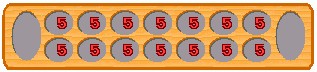
The board or the Mane looks like this. Usually it is played using tamarind seeds. But any other seeds can also be used. At the start of the game each hole contains five seeds.
AliGuliMane1.jpg
  1. The first player picks up the seeds of one of his holes and distributes them into the following holes one by one anti-clockwise.
  2. After dropping the last seed into a hole, the contents of the following hole are distributed in another lap.
  3. The move ends when the following hole is empty. This is called "saada".
  4. If the hole is empty, the player captures the contents of the succeeding hole. In addition, he captures the contents of the hole opposite to that hole.
  5. Each turn a player may move twice, if he captures in his first move. Then his term ends after two "saadas".
  6. A player must move unless he has nothing to play with.
  7. The game is finished when all counters are taken.
  8. The player who has collected most counters wins the game.
  9. In the next round, each player tries to fill his holes with five counters from his winnings. These holes which cannot be filled are marked with a pebble or a twig and are avoided for further play. The match is continued until one player is unable to fill even one hole.


It is such an addictive game. Do share your experiences if you have played this game or if you still have this at home. 

A Special Independence Day!

Yesterday I got an opportunity to witness the Independence Day celebrations and be a part of cultural activities at a school function. 
As the flag was hoisted and the National Anthem was sung, I realized, it has been so many years since I attended any Flag hoisting ceremonies. A sense of pride set in as I sang the National Anthem looking at the fluttering National Flag . 

Once I was out of school, it was as if the celebration of National Festivals was over. We used to hoist the Flag on the terrace of our house for couple of years after out from school. With great difficulty, few times I have even visited the Manek Shaw Parade ground in Bangalore to witness the Flag Hoisting and catch a glimpse of the parade. But yesterday was something different, something special. Proud to be an Indian!

Happy Independence Day!

Mysore Pak


Mysore Pak, a very popular South Indian sweet and a favorite of all. There are two kinds of Mysore Pak. One is a bit hard, perforated one, the other soft and melt
s in the mouth (we call it 'Special Mysore Pak').


I have very fond memories of this Special Mysore Pak. My mama (maternal uncle) used to bring this home whenever he used to visit us when we were kids. We
all brothers and sisters used to relish this special mysore pak nibbling at it for hours. Yesterday was my mother's b'day and i made this for the first time. It was a hit :)

Ingredients :

Chick pea flour (besan) - 2 cups
Warm and liquid clarified butter - 1 and 1/2 cups
Sugar - 2 cups
Water - 1/4 or 1/2 cups

Procedure :

1. Put besan in a bowl. Use fresh besan for best results. See that there are no lumps in them, if so you can sieve it
2. Put 1/2 cup warm ghee and mix well making sure there are no lumps
3. Pour the remaining 1 cup ghee and mix well again, let it sit for 15 to 20 min. The mixture looks somewhat like this


4. After 20 min. place a thick bottomed pan, put sugar and half cup water. Let it boil till one string consistency is attained. Lower the heat
5. Now slowly add this above mixture stirring continuously. Keep stirring until the mixture thickens and the oil starts separating from the sides
6. Grease a deep tray or a plate. Pour this mixture. It will solidify quickly within few minutes. When you feel it is getting solidified cut it into desired shape

[Note: To test if done, pour a small drop of the mixture on the plate, if it becomes solid immediately, that means its done]


Did You watch it?


It's a bird. It's a plane, It's Superman
No its not Superman......its the Celestial Beacon!!

I did watch it. But only a partial one. I know people at different geographies have witnessed
different levels and stages of the eclipse.

Whenever I watch a Solar Eclipse, my mind travels back in time to the First Eclipse I had witnessed. The memories are so vivid.

I was in 6th or 7th std. The "eclipse" thing was new to us then. We were quite excited and eager to see it. We had already started counting the days, as if it was for our birthday.
Teachers had left no points untold about the whole phenomenon and other details. Enough guidance and instructions were given about the "Dos and Don'ts" by them.

Specially designed glossy "eclipse sunglasses" were on sale at school which we had bought without fail. And finally the moment had come. It started getting dark slowly and slowly. We could hear the chirping of birds on their way back to nests assuming it was sunset.....

We were very busy trying to catch each glimpse with that one sunglass, turn by turn, (we could have used an x-ray sheet or a photo negative....but....excitement of watching sun through those sunglasses was something else!)

We got to witness the complete phenomenon. That was an ecstatic feeling. (The sun had suddenly become the center of attraction for the whole world that day)

Hey do you remember this Nandu, Aru, Jnani?


Related Posts Plugin for WordPress, Blogger...